
Plaster Cracks: Choosing a Plasterer, and When the Crack Is Not a Plastering Job
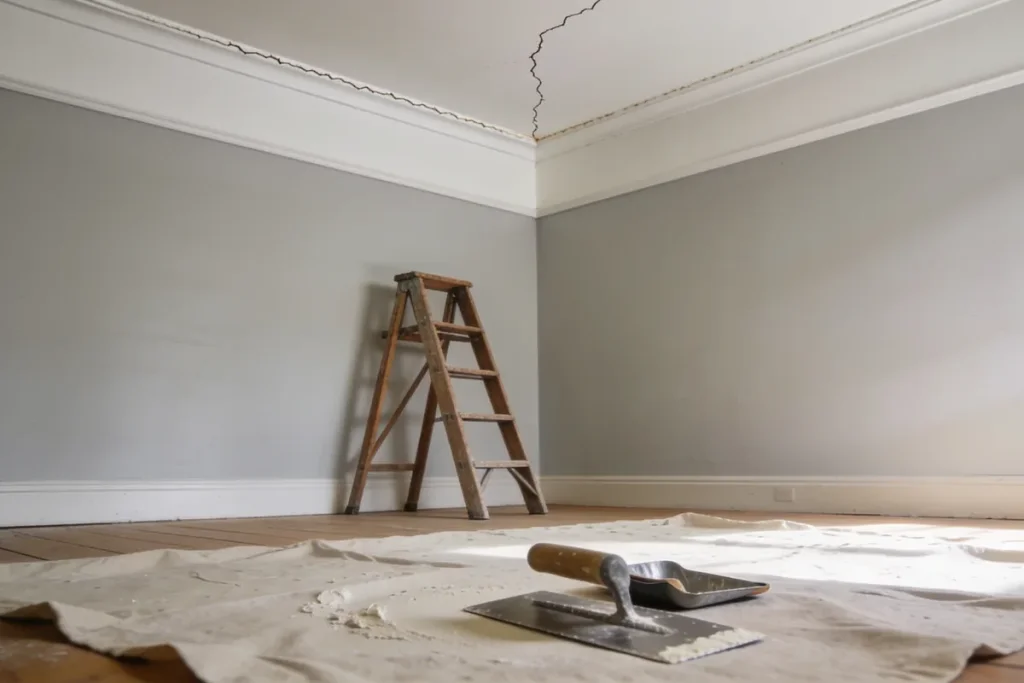
You notice it over your first coffee: a thin line across the ceiling that you are fairly sure was not there last week. If your stomach dropped a little, that is a normal reaction, and you are far from the only person it has happened to. Most cracks in plaster are cosmetic. Timber dries out, houses shift a little with the seasons, and the joins between plasterboard sheets are often the first place any of that shows. There is one rule worth holding on to before anyone picks up a trowel, though: find out why it cracked before you pay to have it patched. A patch over a crack with a cause behind it tends to come back. The checklist below helps you work out which kind you have, and the rest of this guide goes through each step.
Before you book a plasterer
0 of 11 checkedWork down the list. If any of items 2 to 6 does not apply, item 7 is your next step.
Cracks a plasterer can simply fix
Plenty of cracks really are just plaster, and you might recognise a few of these.
- A fine line along the cornice, where the ceiling meets the wall. Ceilings and walls move slightly differently, and that join is where it shows.
- Nail or screw pops: small round bumps or rings, often in a neat row, where a fixing behind the sheet has pushed the plaster outward.
- A cracked sheet join, which is a straight line across a ceiling or down a wall following the edge of a plasterboard sheet, where the tape and setting compound have let go.
- The hole left after another trade. When an electrician, plumber or air-conditioning installer cuts into a wall or ceiling, someone has to close it up and make it disappear again.
For these, a plasterer will usually suggest one of two approaches. A patch means opening up the crack, re-taping or refixing where needed, then setting, sanding and finishing it so it blends in with the rest of the surface. Sheet replacement means taking out a section of plasterboard and fitting a new piece, which makes more sense when a sheet has sagged or crumbled, or has been patched so many times it never quite sits right.
Neither option is wrong. It is perfectly fine to ask the plasterer why they have suggested one over the other, and a good one will be happy to explain it in plain words.
Cracks that are not a plastering job (yet)
This is the part that matters most. It is also the easiest one to skip when all you want is for the ceiling to look nice again.
If the crack is damp or stained, or the plaster around it feels soft, and it sits under a bathroom, a laundry or a part of the roof, call a plumber or a roofer before you call a plasterer. Water is the likely suspect, whether from a leaking pipe or from waterproofing in the shower above that has given up. New plaster over a wet one only hides the problem, and the water keeps doing its work behind the sheet.
Other signs suggest something is moving rather than just settling. You might notice:
- a crack that keeps reopening after it has been patched
- a crack that gets longer or wider over a few weeks
- a crack that runs diagonally from the corner of a door or window
- doors or windows that have started to stick, or no longer close properly
- matching cracks in the brickwork or render outside
If any of those sound familiar, ask a builder or a structural engineer to look before a plasterer does. Try not to panic about it. Plenty of homeowners are told their house is simply moving with the soil, and sometimes that turns out to be all it is. Whether that is what is happening in your home, though, is a question for someone qualified to judge it on site. It is not something you, or a plasterer, should try to diagnose from a photo.
While you wait, take a photo of the crack and write the date down. If it changes, those photos will tell the next person far more than your memory can.
If you are buying a home rather than living in it already, a crack that has been freshly painted over is worth a question too. Our guide to getting a building and pest inspection before auction explains what an inspector looks for and how to read the report.
Who must be licensed, by state
If you have never had to check a tradesperson’s licence before, this bit can feel like homework. It is simpler than it looks. The rules for plastering work differ around Australia, depending on where you live, how big the job is and what it involves, and the three largest states handle it like this.
New South Wales. You need a licensed contractor for residential building work worth more than $5,000, including GST, in labour and materials. Dry plastering and wet plastering are both licensed trades in NSW, so for a job over that amount, check that your plasterer holds the right licence.
Victoria. Registration with the Building and Plumbing Commission is generally needed for domestic building work over $10,000. Work that involves only one trade is exempt, though, and plastering is on that list. So a plastering-only job does not need a registered builder. Registration does apply when plastering is combined with another trade (Consumer Affairs Victoria’s own example is plastering and painting), or when the work is structural, whatever it costs.
Queensland. A QBCC licence is needed for building work over $3,300.
Everywhere else. Check with your state or territory’s building regulator, because the thresholds and trade lists differ.
Whichever state you are in, one small step is worth the few minutes: look the licence or registration up on your state’s public register before you pay a deposit. It takes a few minutes, and it is much easier than chasing a problem afterwards. And if your plasterer offers to paint as well, keep the Victorian rule in mind, since adding a second trade can change what the job needs.
What a plastering quote should list
A good quote is written so that you and the plasterer are picturing the same job. When one arrives, you might look for:
- the area and the rooms included
- whether each crack will be patched or the sheet replaced
- any cornice work
- the finish level, such as set, sanded and ready for paint
- whether painting is included, and if it is, whether that makes it a two-trade job
- cleanup and dust protection for floors and furniture
- a start date and roughly how long the work will take
- the deposit, and when the balance is due
Dust protection deserves its own mention. Sanding plaster makes a fine dust that finds its way into everything, so it is reasonable to ask how floors, furniture and any open shelves will be covered. You might also ask what happens if the same crack comes back after a few months, and have the answer written on the quote rather than left to memory.
Having all of this in writing protects you both. Our guide to choosing a granny flat builder explains why a written contract matters on bigger building jobs, and the same habit is just as useful on a smaller one.
Comparing two quotes
It can be a bit of a shock when two quotes for the same ceiling come back a long way apart. Usually the gap is about scope rather than anyone’s rate. One quote might cover a quick patch along a single cornice, while the other replaces a sheet, redoes the cornice in two rooms and leaves everything ready for paint.
To compare them fairly, lay the two quotes side by side and go through them line by line.
- Is each one patching, replacing, or a mix of both?
- Are the cornices included in both?
- Is painting in one quote and missing from the other?
- Do both cover dust protection and cleanup?
- Is the finish level the same?
If something is missing, ask about it. You are not being difficult. You are making sure you are comparing like with like.
And if one quote is much cheaper because it skips the question of why the crack appeared, that is worth a pause. A patch over an unfixed leak or a moving wall is likely to crack again, and then you end up paying for the same job twice.
An example of two quotes
Here is a made-up example to show how this plays out. Say a ceiling in a Melbourne living room has a fine crack along the cornice. It is dry, there is no bathroom above it, the doors close normally and there is nothing matching outside. It looks like a plaster job.
Two plasterers come to look. The first quote says “repair crack” and gives a single figure. The second lists the room, patching along the cornice on one wall, setting and sanding to a finish ready for paint, drop sheets over the floor and furniture, a start date and the deposit. The second is higher.
Going through them line by line, you find the first quote does not mention cornice work, finish level or cleanup. Before choosing, you ask the first plasterer to write those in. Once both quotes describe the same job, you can compare them fairly. Because the job is plastering only, in Victoria it falls within the single-trade exemption. If either plasterer added painting, it would become a two-trade job, and that can change what it needs.
Fix the cause, then the crack
A new crack is unsettling, but most of the time it is a plaster problem with a plaster fix. Before you book anyone, take a moment to rule out the other kind. If it is damp, under a wet area, or keeps coming back with sticking doors or cracked brickwork outside, call a plumber, builder or engineer first. Once the cause is sorted, or you are confident there is not one, ask for two quotes that list the same work and check the plasterer’s licence or registration where your state needs one. Then you can let them make the ceiling look like nothing ever happened.
Sources: Checking your contractor or tradesperson is qualified, NSW Government (https://www.nsw.gov.au/housing-and-construction/building-or-renovating-a-home/preparing/checking-your-contractor-or-tradesperson-qualified); About builders, tradespeople and other building practitioners, Consumer Affairs Victoria (https://www.consumer.vic.gov.au/housing/building-and-renovating/plan-and-manage-your-building-project/about-builders-tradespeople-and-other-building-practitioners); Building work, QBCC (https://www.qbcc.qld.gov.au/resources/building-work)