
Skin Cancer Checks: GP, Skin Clinic or Dermatologist, and What a Full Check Covers
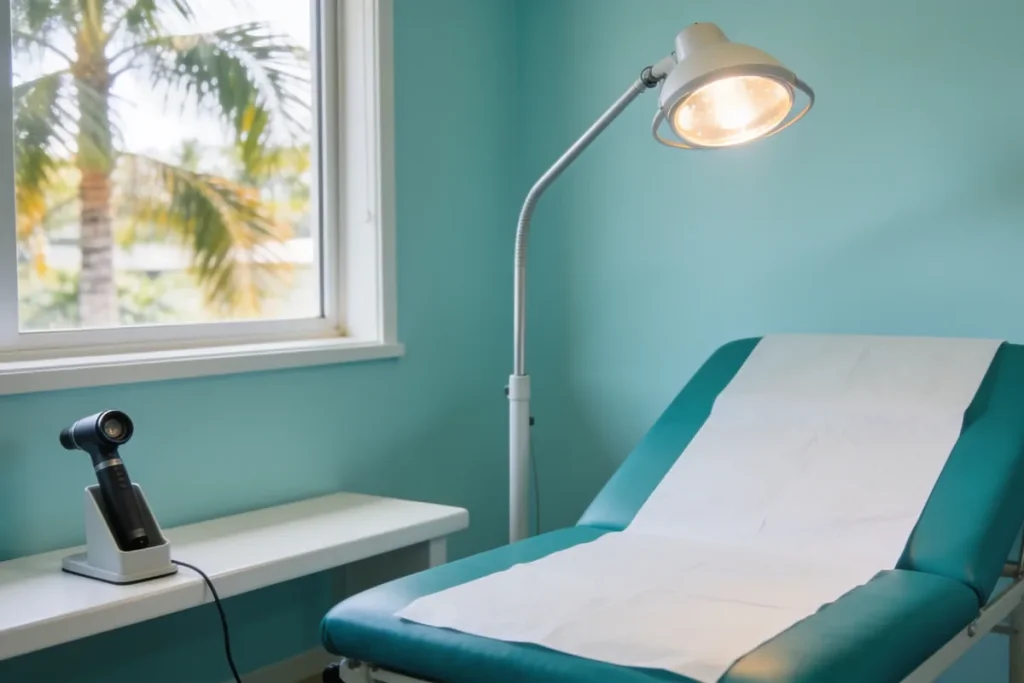
Each year, as the weather warms, Australians are reminded to have their skin checked. The reminder is sound, but it leaves a practical question unanswered: checked by whom? A person booking a first skin cancer check has three broad options. The first is a general practitioner. The second is a skin cancer clinic, a practice that concentrates on skin examinations. The third is a dermatologist, a medical specialist in conditions of the skin.
Each option has a place, and the right choice depends on the person’s level of risk, the reason for the check and the questions that are asked before booking. This guide sets out who should have regular checks and how often, what a full skin check involves, how the three options differ, what mole mapping is and for whom it is intended, and the questions to ask a practice before the appointment. It draws on the position statement on early detection of skin cancer published by Cancer Council Australia. It is general information and is not medical advice. Any change in the skin should be assessed by a doctor.
Who needs checks, and how often
Cancer Council Australia’s position statement on the early detection of skin cancer, published in January 2019 and endorsed by the Australasian College of Dermatologists, begins from a point that surprises many readers. It does not recommend a population screening program for skin cancer. In other words, there is no general recommendation that every adult in Australia should have a routine skin check at a fixed interval.
The statement instead distinguishes between people at higher risk and everyone else.
People at higher risk
People at higher risk of skin cancer include those with:
- fair skin that burns easily
- a large number of moles, or moles that are unusual in appearance
- a first-degree relative, such as a parent, sibling or child, who has had melanoma
- a previous melanoma or a previous keratinocyte cancer
- a suppressed immune system
For people in this group, the statement refers to the Royal Australian College of General Practitioners (RACGP) guidance that clinical skin examinations should take place every six to twelve months.
People at high risk of melanoma
Within the higher-risk group, the statement identifies people at high risk of melanoma specifically. For these people, it supports a six-monthly full skin examination, supported by total body photography and dermoscopy. Whether a particular person falls into this category is a clinical judgement, and a doctor is the appropriate person to make it.
Everyone else
For people who are not at higher risk, the advice is to know their own skin and to see a doctor about any change. This should not be read as a lesser recommendation. It places responsibility for noticing change with the person best placed to notice it, and it is supported by the self-check guidance set out later in this guide.
A person who is unsure which group applies may reasonably ask a GP to assess their risk. The answer will determine whether regular checks are advised and, if so, how often.
What a full check involves
A full skin check is an examination of the whole body. A person attending for one should expect to undress fully and may be offered a gown. The examination should extend to areas that are easily overlooked. Cancer Council’s self-check guidance lists several of them, and the same areas should be covered in a clinical examination:
- the soles of the feet
- the skin between the fingers and between the toes
- under the nails
- the scalp
A check that covers only the arms, back and face, or that examines only a spot the patient has pointed to, is not a full skin check. A patient is entitled to ask, before the appointment, whether the examination will cover the whole body.
Dermoscopy
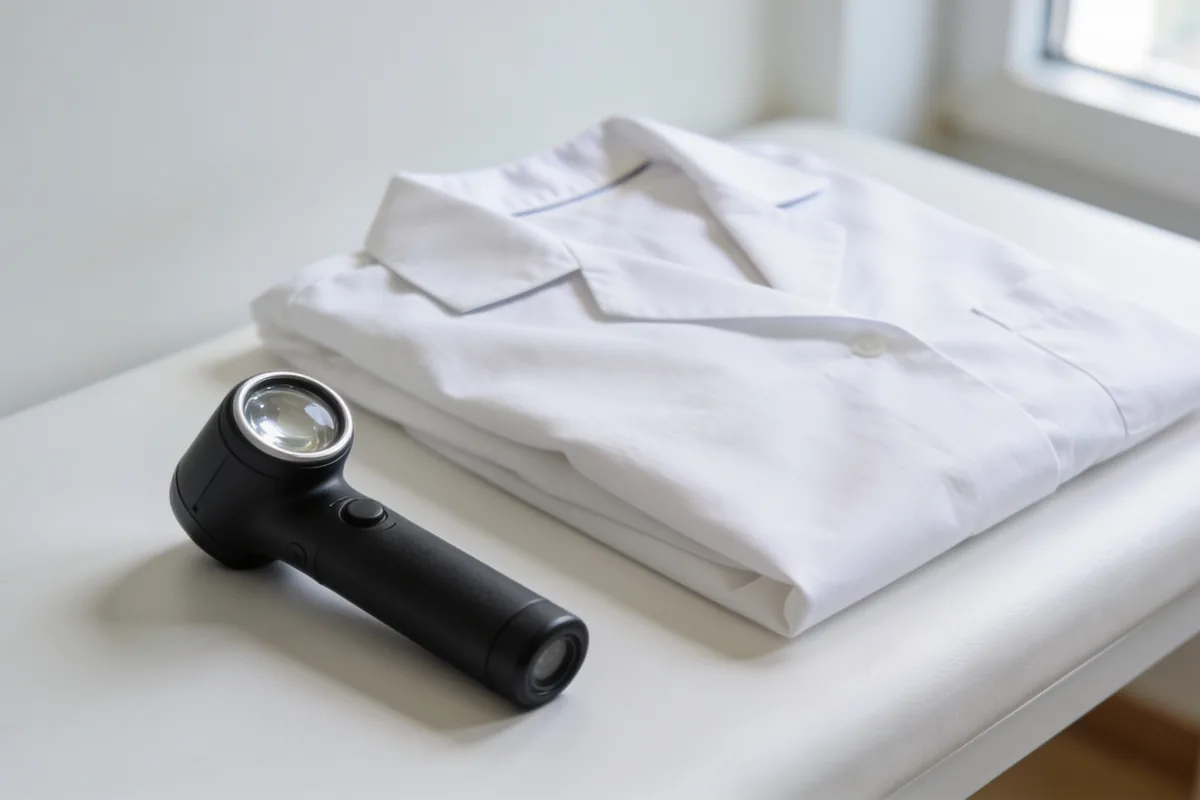
Dermoscopy is the examination of a skin lesion using a dermatoscope, a handheld instrument that magnifies the skin and illuminates it so that structures below the surface can be seen. Cancer Council Australia recommends that clinicians who examine skin are trained in dermoscopy and use it. A patient may ask whether the doctor will use dermoscopy during the check, and the answer is a useful indication of how the examination will be conducted.
What follows the examination
If the doctor finds a lesion of concern, several outcomes are possible. The doctor may recommend monitoring and a review at a later date. The doctor may take a biopsy, in which a sample of the lesion is removed for examination by a pathologist. The doctor may recommend excision, in which the whole lesion is removed. Alternatively, the doctor may refer the patient to a dermatologist or another specialist. The patient should be told which of these is proposed and why.
GP, skin cancer clinic or dermatologist
The three options are not ranked. Each has a role, and the choice should follow from the patient’s circumstances rather than from the assumption that a specialist is always preferable.
| Option | What it is | Points to check |
|---|---|---|
| General practitioner | A GP can perform a skin check, take a biopsy where appropriate and refer to a specialist | Whether the GP performs full skin checks and uses dermoscopy |
| Skin cancer clinic | A GP-type practice that concentrates on skin examination | The examining doctor’s training in skin cancer medicine, and whether dermoscopy is used |
| Dermatologist | A medical specialist in conditions of the skin | Whether a referral is needed for a Medicare rebate, and the expected cost |
The general practitioner
A GP is often the most practical starting point. A GP who knows the patient’s history can assess risk, perform the check, take a biopsy where appropriate and refer to a dermatologist if that is warranted. Not every GP performs full skin checks routinely, so a patient booking for that purpose should say so at the time of booking, so that the appointment is long enough. This site’s guide to finding a bulk-billing GP explains how to establish the billing arrangement for an appointment before it is made.
The skin cancer clinic
A skin cancer clinic is a general practice-type service that concentrates on the examination of skin. The doctors who work in such clinics are typically general practitioners. The clinic’s focus may mean that its doctors examine a large number of skin cases, but the name of the clinic does not, of itself, describe the training of the doctor who will conduct the check. A patient should ask what training the examining doctor has in skin cancer medicine and whether dermoscopy is used.
The dermatologist
A dermatologist is a medical specialist. A dermatologist may be the appropriate choice for a patient at high risk, for a patient with a lesion that a GP has identified as a concern, or for ongoing monitoring of complex cases.
One condition applies to cost. A visit to a specialist without a referral will not generally attract a Medicare rebate. A patient intending to see a dermatologist should therefore obtain a referral first, usually from a GP, and should confirm with the dermatologist’s practice before booking what the cost will be and what rebate, if any, will apply.
Mole mapping and total body photography
Mole mapping, which is often described as total body photography, is a process in which photographs of the patient’s skin are taken and stored so that they can be compared over time. At a later appointment, the new images can be set against the stored ones to identify moles that have changed, and any new moles that have appeared.
The value of the process lies in comparison. A single examination shows what the skin looks like on one day. A series of stored images allows a doctor to see what has changed between examinations, and change is one of the more important indicators that a lesion warrants closer attention.
As set out above, Cancer Council’s position statement supports total body photography, together with dermoscopy, for people at high risk of melanoma. It is mainly intended for that group. A person at average risk should not assume that mole mapping is necessary, and should discuss with a doctor whether it is appropriate in their case.
The cost of mole mapping should be confirmed before the appointment. Where images are stored and scanned for comparison, the practice may charge for that separately, and the charge may not be included in the consultation fee. A patient should ask what is included and what is charged separately before agreeing to the service.
Questions to ask before booking
The following questions allow a patient to compare practices on the matters that bear on the quality and cost of the check. They are best asked at the time of booking.
- Who will examine me, and what training do they have in skin examination? The answer distinguishes a GP, a GP with additional training in skin cancer medicine and a dermatologist.
- Is dermoscopy used? Cancer Council recommends that it is.
- Will the examination cover the whole body? A full check includes the scalp, the soles of the feet, between the fingers and toes, and under the nails.
- What is the full cost, and what is the Medicare rebate? The patient should know the out-of-pocket amount before the appointment.
- Is photography included, or is it charged separately? If mole mapping is offered, the patient should know what each part of it costs.
- What happens if something is found? The patient should know whether a biopsy or excision can be performed on site, and how a referral to a specialist would be arranged.
These questions follow the same principle set out in this site’s guide on how to choose a dentist: the information that matters most is often not in the advertisement, and it can be obtained by asking before the appointment.
Between checks
A clinical skin check is a single examination at a point in time. Between examinations, the person most likely to notice a change in the skin is the person whose skin it is. Cancer Council encourages people to become familiar with their skin, including the areas listed earlier, and to check it regularly.
The ABCDE guide
Cancer Council’s self-check guidance uses the ABCDE guide to describe features of a spot that warrant a doctor’s attention:
- A, asymmetry. The two halves of the spot do not match.
- B, border. The edge of the spot is irregular, blurred or notched.
- C, colour. The colour is uneven, or there are several colours within the spot.
- D, diameter. The spot is larger than other spots, or is growing.
- E, evolving. The spot is changing in size, shape, colour or texture.
A new mole that appears after the age of 25 is also a reason to see a doctor. So is any spot that is different from the person’s other spots, or that has changed.
Apps
Smartphone applications that claim to assess moles are widely available. Cancer Council does not recommend them for self-diagnosis. An app is not a substitute for examination by a doctor, and a person who has noticed a change should book an appointment rather than rely on an application’s assessment.
A future screening program
The position on population screening may change in future. The federal government has funded the development of a roadmap for a targeted national skin cancer screening program, led by Melanoma Institute Australia. The roadmap remains in development. Until any such program is in place, the recommendations set out above continue to apply.
The skin is not the only part of the body that benefits from a regular check at a set interval. This site’s guide to booking an eye test with a Medicare optometrist explains how often an eye examination is covered, and the two appointments can sensibly be planned together.
Book the check, then keep the date
There is no population screening program for skin cancer in Australia, and Cancer Council Australia does not recommend that every adult be checked at a fixed interval. People at higher risk, including those with fair skin that burns, many or unusual moles, a first-degree relative with melanoma, a previous skin cancer or a suppressed immune system, are advised to have clinical skin examinations every six to twelve months. People at high risk of melanoma are advised to have a six-monthly full skin examination supported by total body photography and dermoscopy. Everyone else should know their own skin and see a doctor about any change.
A full check covers the whole body, including the scalp, the soles, between the fingers and toes, and under the nails, and should be conducted by a clinician trained in dermoscopy. A GP, a skin cancer clinic and a dermatologist can each perform the check, and the choice should follow from the patient’s risk and circumstances. A specialist visit without a referral will not generally attract a Medicare rebate, and the cost of any photography should be confirmed in advance.
Once a check has been completed, the most useful step is to record when the next one is due and to book it. Between appointments, the ABCDE guide and a regular look at one’s own skin remain the most reliable way to notice change early.
Sources: Early detection of skin cancer position statement, Cancer Council Australia (https://www.cancer.org.au/about-us/policy-and-advocacy/prevention/uv-radiation/related-resources/early-detection-of-skin-cancer); Check for signs of skin cancer, Cancer Council Australia (https://www.cancer.org.au/cancer-information/causes-and-prevention/sun-safety/check-for-signs-of-skin-cancer); Roadmap for a National Targeted Skin Cancer Screening Program, Melanoma Institute Australia (https://melanoma.org.au/news/roadmap_for_skin_cancer_screening_program/)