
Buying at Auction? Book the Building and Pest Inspection Before the Bidding
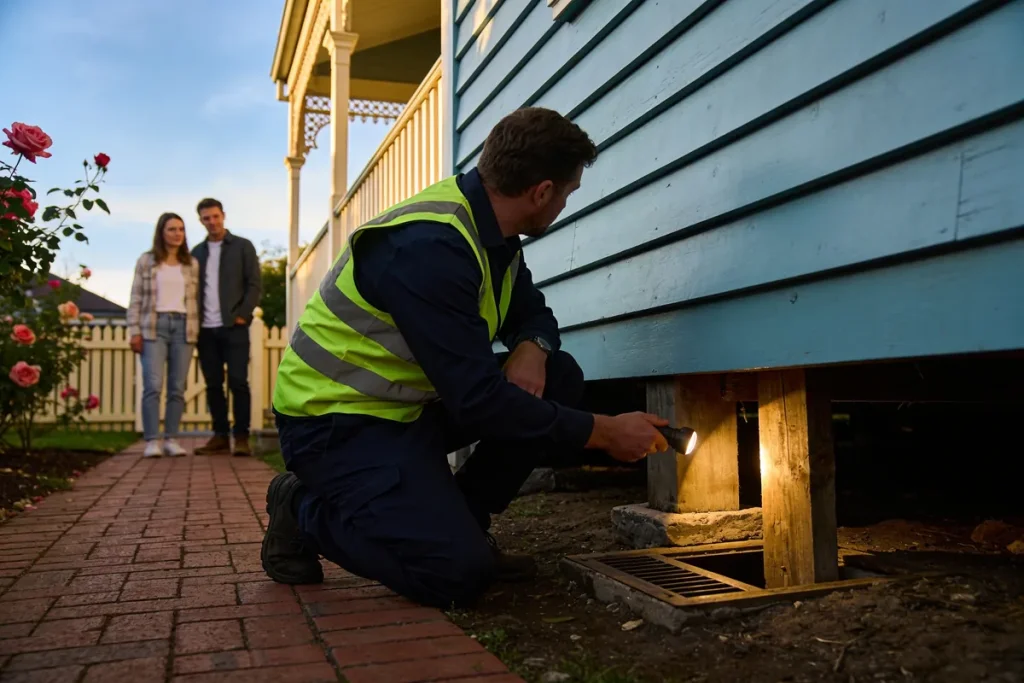
At an auction in Victoria or New South Wales, the contract is signed on the day. The successful bidder leaves with a binding contract, a deposit already paid and, under the rules both states apply, no cooling-off period in which to reconsider. That single feature of the auction process changes the order in which a careful buyer should work.
A building and pest inspection is often treated as something that follows an agreement. At auction that sequence cannot hold. Whatever the inspection would reveal about the roof, the subfloor or the timber, the buyer needs to know it before the first bid is placed, because once the hammer falls the information can no longer change the outcome.
This guide sets out why the regulators place the inspection ahead of the auction, what the two inspections cover and leave out, how to choose an inspector whose report will hold up, and how the findings should shape a bidding limit. It is general information about the process and is not legal advice.
Why auction day changes the order
Consumer Affairs Victoria describes what happens when a property is sold under the hammer. The successful bidder signs a contract on the terms displayed before the auction. Further conditions, such as making the purchase subject to finance, cannot be added unless the seller agrees. The bidder pays the deposit and, in the regulator’s own words, there is no cooling-off period.
The same position can arise before auction day. Consumer Affairs Victoria advises that where a pre-auction offer is accepted less than three clear business days before the auction, the buyer has no cooling-off period either. A buyer negotiating late in a campaign should therefore treat a pre-auction offer with the same care as a bid on the day.
New South Wales follows a similar line. The NSW Government states that there is no cooling-off period when a property is bought at auction, and none where contracts are exchanged on the same day after the property has been passed in. The deposit is paid on the spot, and the NSW Government notes that it is usually 10% of the price.
A private sale works differently. In New South Wales, a private-sale buyer ordinarily has a cooling-off period of five business days, and a buyer who withdraws during that period forfeits 0.25% of the purchase price. That period gives the buyer time to reconsider after signing. An auction buyer has no equivalent, so any checking has to be finished before the contract exists.
The NSW Government’s guidance for auction buyers is direct on the point: before bidding, obtain building and pest reports, together with strata reports where the property is part of a strata scheme. Consumer Affairs Victoria frames its advice the same way, recommending that a buyer engage a qualified inspector before signing. Read together, the two regulators leave little room for the idea that an inspection can wait. A buyer who bids without one accepts the building in whatever condition it proves to be in, with the deposit already committed.
Two inspections, two standards
The phrase “building and pest inspection” covers two separate inspections that are commonly booked together. They are carried out against different Australian Standards and answer different questions.
The building inspection is carried out to AS 4349.1-2007, the standard used for pre-purchase inspections of residential buildings. It is concerned with the condition of the building: its structure, its significant defects and its state relative to its age and type. The timber pest inspection is carried out to AS 4349.3-2010, Part 3 of the same series, which deals with timber pest inspections and sets minimum requirements for a non-invasive inspection. In practice, that limits the inspector to what can be seen and reached without opening up the building.
Standards Australia lists both standards as pending revision. A report should name the standard it was prepared against, with the year, and the inspector should be able to say which edition was applied.
There is a practical reason to keep the two apart. The NSW Government notes that a building report generally does not include termite detection, so a buyer who orders only a building inspection may receive a careful account of the roof, walls and site with no assessment of timber pest activity at all. Consumer Affairs Victoria likewise advises arranging a pest inspection separately. Where the two are booked together, the buyer should confirm that both scopes are written into the engagement and that the pest component is reported to AS 4349.3-2010. One invoice for both does not, by itself, show that both were done.
What the report should cover
The NSW Government sets out the areas a pre-purchase building inspection is expected to examine: the interior, the exterior, the roof space, the under-floor space, the roof exterior and the site. The site here includes the garage, carport and any shed, small retaining walls that are not structural, fencing, drainage, stormwater run-off and paths.
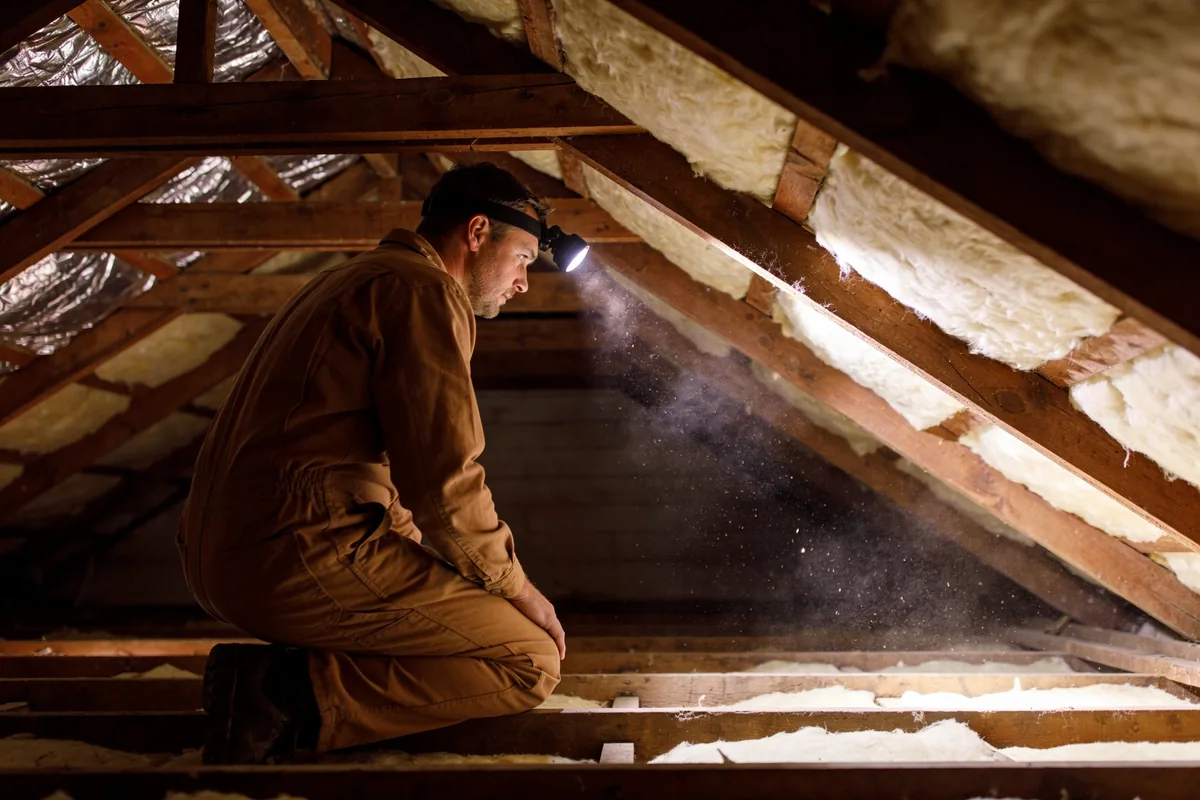
The roof space and the under-floor space deserve particular attention from an auction buyer, since they are the parts of a house a buyer is least able to see at an open inspection. A report that records both as inspected, with the means of access noted, gives the buyer far more to work with than one that marks them as inaccessible.
The content of the report matters as much as its coverage. According to the NSW Government, a pre-purchase report should:
- state which parts of the property were not inspected, and why;
- summarise the overall condition of the property, having regard to its age and type;
- list the significant problems found; and
- recommend specialist advice where it is needed, for example from a structural engineer, a pest inspector or a surveyor.
The first requirement deserves the closest reading. A report can only speak to what the inspector was able to examine. Where a roof void could not be entered, a subfloor was too low to crawl or a room was locked, the report should say so plainly. A long list of areas not inspected is a finding in its own right, and it may justify a request for access and a second visit before auction day.
The fourth requirement carries similar weight at auction. A recommendation for a structural engineer or a surveyor means the inspection has raised a question it cannot answer. On a private sale there may be time to pursue that after signing. At auction, it has to be dealt with before the buyer bids.
What it usually leaves out
A standard pre-purchase report has defined limits, and a buyer who knows them can plan around them. The NSW Government lists the matters generally excluded: the footings, concealed damp-proofing, electrical wiring and smoke alarms, plumbing and gas, air conditioning, swimming pools and appliances. Minor defects are also generally excluded unless the buyer orders a special-purpose report, and many reports give no estimate of repair costs.
Each exclusion points to a specialist. Wiring and smoke alarms are a matter for an electrician, and a buyer arranging that check can apply the approach this site sets out for what to check before hiring an electrician, beginning with the licence. Plumbing and gas call for a licensed plumber, and a pool or an air conditioning system is best assessed by someone who works on them.
The absence of repair-cost estimates is the exclusion most likely to catch a buyer out. A report may describe a defect clearly without saying what it will cost to fix, yet that cost is what the bidding limit depends on. It usually has to come from a tradesperson’s quote, as discussed below.
Consumer Affairs Victoria also raises asbestos in homes built before 1990. A building inspection is not an asbestos assessment, so a buyer looking at an older home should ask the inspector whether any suspected material was noted and what further advice is recommended.
Choosing the inspector
The regulators’ descriptions of a suitable inspector are consistent. The NSW Government advises using a suitably qualified person, such as a licensed builder, a surveyor or an architect, who holds professional indemnity insurance. Consumer Affairs Victoria advises engaging a qualified building inspector, surveyor or architect, checking that the practitioner is registered, and confirming that they hold full professional indemnity insurance.
Queensland deals with the matter through licensing. The Queensland Building and Construction Commission (QBCC) issues a completed residential building inspection licence, which covers inspecting completed residential buildings and reporting on them to AS 4349.1-2007. A Queensland buyer can ask for the inspector’s QBCC licence and confirm that it is the class covering this work.
Consumer Affairs Victoria adds a caution that applies anywhere: be wary of a report offered by the selling agent or the seller. Such a report may be accurate, but it was not commissioned by the buyer or written to the buyer’s questions.
Before engaging an inspector, a buyer should ask:
- What licence or registration do you hold, and in which state?
- Do you hold current professional indemnity insurance, and will you confirm it in writing?
- May I see a sample report?
- Will you enter the roof void and the subfloor, and what will the report say if either cannot be accessed?
- Is the pest inspection carried out to AS 4349.3-2010 and reported separately?
- When will the written report arrive, and will that leave time to act on it before auction day?
The last question matters most in an auction campaign, because a thorough report that arrives after the auction is of no use to the bidder. The turnaround should be confirmed when the booking is made.
This guide does not quote fees. Consumer Affairs Victoria’s framing is the relevant one: the fee for an inspection is small next to the cost of a repair nobody saw coming.
Timing it against the campaign
An auction campaign gives the buyer a fixed date to work back from. A practical sequence is to view the property, decide whether it is a serious prospect, and then book the inspection well before the final week. That leaves room for specialist advice, for quotes on significant findings, and for a second visit if parts of the property could not be reached the first time. Access is arranged through the selling agent, and the request is best made early.
In New South Wales, the agent has an obligation that can help. When a buyer asks for a copy of the contract, the agent must disclose any previous inspection reports commissioned on the property, and the buyer may be able to obtain one at low cost. It can be a useful first look. An independent report commissioned by the buyer remains the safer basis for a bidding decision, for the reasons Consumer Affairs Victoria gives about reports offered by the agent or seller.
In Victoria, the agent must have the due diligence checklist available at open inspections. The checklist prompts the matters a buyer should look into before committing, and a buyer who collects it at the first open inspection has the rest of the campaign to work through it alongside the inspection booking.
Strata properties need a further adjustment. The NSW Government notes that, for a strata property, the inspection generally covers only the interior of the unit and its immediate exterior unless a special-purpose report is requested. The common property is a separate question, which is why the NSW Government also recommends strata reports before bidding.
From report to bidding limit
A report becomes useful when its findings are turned into a figure the buyer will not go past on the day. One sensible method is to sort every significant finding into four groups. Safety items affect the people living in the house and need prompt attention. Structural items affect the building itself and may need an engineer. Expensive items are not urgent but will cost a substantial amount, such as a tired roof or failing drainage. Cosmetic items affect appearance rather than function.
The first three groups belong in the bidding limit. For the larger items, the buyer should get quotes before auction day, using the report as the scope of work, and take those amounts off the figure they were prepared to pay. Cosmetic work can usually wait for the buyer’s own budget and timetable.
Where the report recommends a specialist, that recommendation works as a gate. The buyer either books the specialist and has the advice in hand before the auction, or does not bid. Bidding while an engineer’s question is still open means accepting a risk the buyer has already been warned about, under a contract with no cooling-off period.
A limit worked out in advance, with the cost of the findings already deducted, is also easier to hold when the bidding moves quickly.
If the bid succeeds, attention turns to settlement and the move, and that planning can start with comparing removalist quotes once the contract is signed. The inspection work belongs to the weeks before the auction.
Bid on what you know
The auction system in Victoria and New South Wales gives the seller certainty: a signed contract, a paid deposit and no cooling-off period. Consumer Affairs Victoria and the NSW Government are both clear about what follows for the buyer, and both advise that the building and pest inspection comes before the bid.
The method follows from there. Book both inspections, to AS 4349.1-2007 and AS 4349.3-2010, with a qualified and insured inspector whose report will arrive in time. Read the list of areas not inspected as closely as the list of defects, and arrange specialists for what a standard report excludes. Then turn the significant findings into quotes and the quotes into a limit, so that on the day the buyer knows what the property is and when to stop.
Sources: Consumer Affairs Victoria, Buying property at auction (https://www.consumer.vic.gov.au/housing/buying-and-selling-property/buying-property/buying-property-at-auction); Consumer Affairs Victoria, Inspect properties before you buy (https://www.consumer.vic.gov.au/housing/buying-and-selling-property/buying-property/inspect-properties-before-you-buy); NSW Government, Contracts and deposits (https://www.nsw.gov.au/housing-and-construction/buying-and-selling-property/buying-property-nsw/contracts-and-deposits); NSW Government, Buying property at an auction (https://www.nsw.gov.au/housing-and-construction/buying-and-selling-property/buying-property-nsw/buying-property-at-an-auction); NSW Government, Pre-purchase inspection reports for buyers (https://www.nsw.gov.au/housing-and-construction/buying-and-selling-property/buying-property-nsw/inspecting-a-property/inspection-reports); QBCC, Completed residential building inspection licence (https://qbcc.qld.gov.au/licences/apply-licence/available-licence/inspectors-certifiers/completed-residential-building); Standards Australia, AS 4349.1-2007 (https://store.standards.org.au/product/as-4349-1-2007); Standards Australia, AS 4349.3-2010 (https://store.standards.org.au/product/as-4349-3-2010)